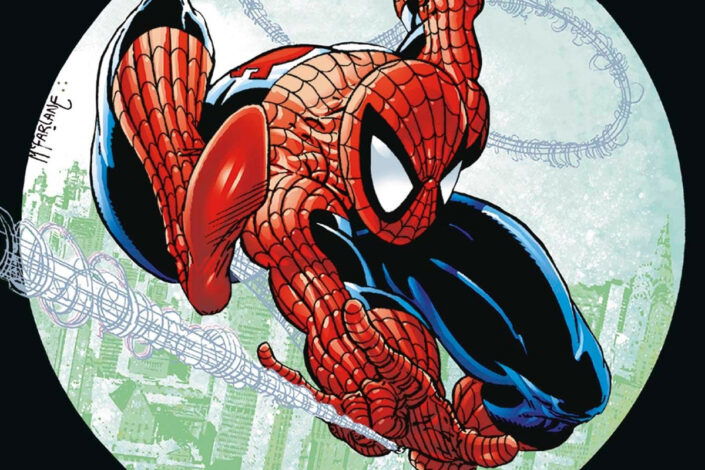
With issue #15 (May 1962), the anthology comic book Amazing Adult Fantasy was renamed Amazing Fantasy after Marvel realized teenagers were uncomfortable buying a title with “Adult” in its name. The issue introduced “The Spiderman,” a teenage superhero created by Stan Lee and Steve Ditko, who was meant to headline the series, but Amazing Fantasy was canceled shortly after. The character, soon renamed Spider-Man, became an instant success and quickly earned his own ongoing comic book series.
Spider-Man’s story begins with Peter Parker, a geeky orphaned high school student from Queens, New York, living with his Uncle Ben and Aunt May. After being bitten by a radioactive spider during a science exhibit, Peter gains spider-like agility and strength. At first, he uses his powers for fame and money, but after refusing to stop a thief who later causes Uncle Ben’s death, Peter learns the lesson that defines his life: “With great power there must also come great responsibility!”
From then on, Peter Parker balances fighting criminals with everyday struggles like helping Aunt May pay the bills, studying, and working as a photographer for the Daily Bugle, where publisher J. Jonah Jameson constantly attacks Spider-Man in print. Over the years, Peter meets Harry Osborn, Gwen Stacy, and Mary Jane Watson while facing enemies like the Green Goblin, Doctor Octopus, and the Sinister Six. His life is marked by tragedy, personal loss, and constant challenges as the Marvel Universe expands around him.
Spider-Man eventually teams up with heroes like the Fantastic Four and The Avengers, becoming one of Marvel Comics’ most important characters. Loved by readers but often hated within his own world, Spider-Man grew into one of the most recognizable fictional characters ever created, starring in movies, television shows, video games, and more.
This article focuses entirely on the comic books, returning to the beginning of Spider-Man’s long publishing history to explore his reading order from the very start.
50¢
Where to start with the Spider-Man Comics?
The first Spider-Man comics were published in 1962. Of course, you don’t have to read everything from the start. In fact, there are multiple perfect entry points in the saga. You have to follow the menu:
- Amazing Fantasy #15, the first comic book issue
- From the late 1960s to the mid-1980s, you could mostly take a book at random and read it.
- Spider-Man: Blue by Jeph Loeb & Tim Sale, a classic fan favourite story set in the early days of Spidey’s adventure.
- Want a classic story to start with: Kraven’s Last Hunt
Now-classic “modern” relaunches, good entry points for new readers:
- The post-Clone Saga era
- Amazing Spider-Man by J. Michael Straczynski [must-read]
- Spider-Man: Brand New Day
- Spider-Man by Dan Slott
- Spider-Man by Nick Spencer
- Spider-Man by Zeb Wells
- Spider-Man by Joe Kelly
You can also read our selection of the Best Spider-Man Comics there is!
We already have multiple comic book reading orders for some specific eras of Spider-Man’s comic book history:
- Spider-Man: Clone Saga (with Ben Reilly!)
- Spider-Man by J. Michael Straczynski
- The Amazing Spider-Man Comics by Dan Slott
- Spider-Man Spider-Geddon (the sequel to Spider-Verse)
- Nick Spencer’s Spider-Man: A Fresh Start
- Amazing Spider-Man Beyond
The Spider-Verse Beyond Peter Parker: We also wrote reading orders and other articles for other characters connected to the Amazing Spider-Man!
- First, Explore the Spider-Verse: Your Guide to Marvel’s Spider Family
- Miles Morales Comics Reading Order (Spider-Man, Champions, Ultimate)
- Jessica Drew Reading Order, the first Spider-Woman
- Black Cat Reading Order, Marvel’s Lucky Cat Burglar
- May “Mayday” Parker Reading Order (Spider-Girl/Spider-Woman from Earth-982)
- Anya Corazon Reading Order (Araña, Spider-Girl)
- Madame Web Reading Order (Cassandra Webb and Julia Carpenter)
- Silk Comics Reading Order, The Adventures of Cindy Moon in the Spider-verse
- Spider-Gwen Reading Order (Gwen Stacy, Spider-Ghost)
- Ben Reilly Reading Order, The other Spider-Man (aka Scarlet Spider)
- Spider-Man 2099 Reading Order (Miguel O’Hara)
- Superior Spider-Man Reading Order, The Otto era
- Spider-Man Noir Reading Order (member of the Spider-Verse)
- Who Is Spider-Ham? The Origin Story of the coolest anthropomorphic pig from Marvel Comics
- Kaine Parker Reading Order, The (second) Scarlet Spider (also Peter Parker’s clone)

The Amazing Spider-Man Comics Reading Order
As of 2026, Marvel Comics is no longer releasing new volumes in the Marvel Masterworks line. These hardcover editions previously formed the backbone of this Spider-Man reading order, particularly for the character’s first two decades of publication. However, as the Masterworks volumes have become increasingly difficult to source, the guide has been restructured to prioritize the Epic Collection series, when possible (there are still gaps in the collection).
More than 30 omnibuses are dedicated to Spider-Man at this time of writing. Find them all in one place! Follow our guide:
See Our Complete Guide to the Spider-Man Omnibus Collection.
From Amazing to Spectacular: Spider-Man in the 1970s
Starting with Amazing Fantasy #15 (1962), the 1960s Spider-Man comics were largely shaped by Stan Lee and Ditko’s work, later continued by John Romita Sr., who helped redefine the series’ tone and visual identity, while introducing key elements such as Peter Parker’s evolving personal life and supporting cast. In the 1970s, writers including Gerry Conway, Len Wein, and Marv Wolfman, alongside artists such as Ross Andru, expanded the series into more complex and consequential storytelling, marked by major developments like the death of Gwen Stacy and the launch of additional Spider-Man titles like The Spectacular Spider-Man.
- Amazing Spider-Man Epic Collection: Great Power
Collects Amazing Spider-Man #1-17 and Annual #1 and material from Amazing Fantasy #15. - The Amazing Spider-Man Vol. 1.1: Learning to Crawl
Collects Amazing Spider-Man (2014) #1.1-1.5 and material from #1. A 2014 series by Dan Slott and Ramon Perez set around the first three issues of ASM. - Spider-Man: Shadow of the Green Goblin
Collects Spider-Man: Shadow of the Green Goblin (2024) #1-4, Spider-Man (1990) #-1. An Early Adventure of Spider-Man by J.M. DeMatteis that was published in 2024. - Amazing Spider-Man Epic Collection: Great Responsibility
Collects Amazing Spider-Man #18-38, Annual #2.
- Amazing Spider-Man Epic Collection: Spider-Man No More [2026 printing]
Collects Amazing Spider-Man #39-52 and Annual #3-4, and material from Not Brand Echh #2. - The Amazing Spider-Man: Torn [2026]
Collects Amazing Spider-Man: Torn (2025) #1-5. A 2025 5-issue series by J. Michael Straczynski and Pere Pérez set around ASM #50. - Amazing Spider-Man Epic Collection: The Goblin Lives
Collects Amazing Spider-Man #53-67, Spectacular Spider-Man #1-2, Marvel Super-Heroes #14, and Material From Not Brand Echh #6 and #11. - Amazing Spider-Man Epic Collection: The Secret Of The Petrified Tablet
Collects Amazing Spider-Man #68-85 and material from Amazing Spider-Man Annual #5. - Amazing Spider-Man Epic Collection: The Death Of Captain Stacy
Collects Amazing Spider-Man #86-104.
Launched in 1972, Marvel Team-Up was an anthology series primarily featuring Spider-Man in a rotating lineup of guest appearances alongside other Marvel heroes such as the Human Torch, Doctor Strange, and the X-Men. The first 30 issues have recently been reprinted in Marvel Team-Up Omnibus Vol. 1.
- Marvel Masterworks: Marvel Team-Up Vol. 1 – Collects Marvel Team-Up (1972) #1-11. The first two issues are set before ASM #100.
- Amazing Spider-Man Epic Collection: The Goblin’s Last Stand [2026 printing]
Collects Amazing Spider-Man #105-123. - Marvel Masterworks: Marvel Team-Up Vol. 2 – Collects Marvel Team-Up (1972) #12-22 & Daredevil (1964) #103.
- Amazing Spider-Man Epic Collection: Man-Wolf At Midnight
Collects Amazing Spider-Man #124-142; Giant-Size Super-Heroes #1; Material from Marvel Treasury Edition #1. - Marvel Masterworks: Marvel Team-Up Vol. 3 – Collects Marvel Team-Up (1972) #23-30, Giant-Size Spider-Man (1974) #1-3.
- Amazing Spider-Man Epic Collection: Spider-Man or Spider-Clone?
Collects Amazing Spider-Man #143-164 and Amazing Spider-Man Annual (1964) #10. - Marvel Masterworks: Marvel Team-Up Vol. 4 – Collects Marvel Team-Up (1972) #31-40, Giant-Size Spider-Man (1974) #4-5.
- Marvel Masterworks: Marvel Team-Up Vol. 5 – Collects Marvel Team-Up (1972) #41-52; Marvel Two-In-One (1974) #17; Marvel Treasury Edition (1974) #9, 13; Marvel Comics Calendar 1976.
- Spectacular Spider-Man Masterworks Vol. 1
Collects Spectacular Spider-Man (1976) #1-5, #7-15, and material from #6, also available in Peter Parker, The Spectacular Spider-Man Omnibus Vol. 1. - Amazing Spider-Man Epic Collection: Big Apple Battleground
Collects Amazing Spider-Man #165-185 and Amazing Spider-Man Annual (1964) #11-12, Nova (1977) #12, and Marvel Calendar 1978. - Marvel Masterworks: Marvel Team-Up Vol. 6 – Collects Marvel Team-Up (1972) #53-64, Marvel Team-Up Annual (1976) #1, Marvel Premiere (1972) #31, Mighty Marvel Calendar 1977.
- Spectacular Spider-Man Masterworks Vol. 2
Collects The Spectacular Spider-Man (1976) #16-31, also available in Peter Parker, The Spectacular Spider-Man Omnibus Vol. 1. - Marvel Masterworks: Marvel Team-Up Vol. 7 – Collects Marvel Team-Up (1972) #65-77.
- Amazing Spider-Man Epic Collection: Nine Lives Has the Black Cat
Collects Amazing Spider-Man (1963) #186-206 & Annual (1964) #13 and The Spectacular Spider-Man (1979) #1. - Spectacular Spider-Man Masterworks Vol. 3
Collects Spectacular Spider-Man (1976) #32-42, Annual (1979) #1; Amazing Spider-Man Annual (1964) #13; Fantastic Four (1961) #218, also available in Peter Parker, The Spectacular Spider-Man Omnibus Vol. 1.
 Black Cat made her first official comic book appearance in The Amazing Spider-Man #194. To learn a little bit more about Felicia Hardy, check out our article about
The Amazing Spider-Man goes Cosmic in the 1980s
Dennis O’Neil and John Romita Jr. made their debuts on The Amazing Spider-Man during the late 1970s, marking a transitional phase in the series’ creative direction. Their early contributions included the introduction of Madame Web! More broadly, during the 1980s, The Amazing Spider-Man slowly moved beyond its street-level roots and went cosmic, following the trends of that time. One of the major developments in Peter Parker’s life is the introduction of the alien symbiote costume during the Secret Wars storyline, which would go on to have lasting consequences for the character and his mythology. Key creative runs by writers such as Roger Stern, Tom DeFalco, and David Michelinie, alongside artists including JR Jr. and Todd McFarlane.
- The Amazing Spider-Man Epic Collection: Spider-Man – Threat or Menace? [2026]
Collects Amazing Spider-Man (1963) #207-223 & Annual (1964) #14-15. - Spectacular Spider-Man Masterworks Vol. 4
Collects Spectacular Spider-Man (1976) #43-55, Annual (1979) #2. - Spectacular Spider-Man Masterworks Vol. 5
Collects Peter Parker, The Spectacular Spider-Man (1976) #56-66 and Spectacular Spider-Man Annual #3. - The Amazing Spider-Man Epic Collection: Nothing Can Stop The Juggernaut [2026]
Collects Amazing Spider-Man (1963) #224-241 & Annual (1964) #16. - Spider-Man is part of a Ka-Zar Storyline: Ka-Zar the Savage #18-27, collected in Ka-zar the Savage Omnibus.
- Spider-Man appeared in Avengers #236-237, collected in Spider-Man: Am I an Avenger?
- Spectacular Spider-Man Marvel Masterworks Vol. 6
Collects Peter Parker, The Spectacular Spider-Man (1976) #67-79. - Marvel Masterworks: Spectacular Spider-Man Vol. 7
Collects Peter Parker, The Spectacular Spider-Man (1976) #80-91.
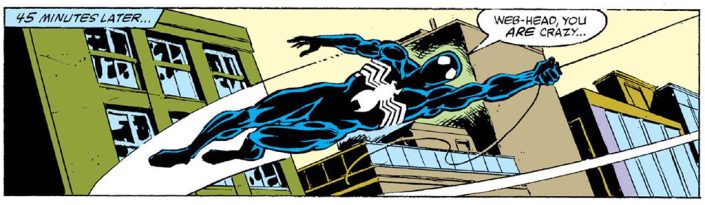
 The Secret Wars! A turning point in Marvel Comics history, the event brought together many of the Marvel Universe’s greatest heroes and villains in a conflict orchestrated by the mysterious and seemingly omnipotent Beyonder. For Spider-Man, the event became especially significant as Peter Parker acquired the black “Alien Costume,” a living symbiotic suit that would permanently alter the character’s mythology and eventually lead to the creation of Venom. You can learn more about its history, check out
 Following his return to Earth, Spider-Man continued using the black alien costume introduced during Secret Wars. This is a period now commonly known as the “Alien Costume Saga.”
- Spider-Man: The Complete Alien Costume Saga Book One
Collects Amazing Spider-Man (1963) #252-258, Marvel Team-Up (1972) #141-145 and Annual #7, And Peter Parker, The Spectacular Spider-Man (1976) #90-95. - Spider-Man: The Complete Alien Costume Saga Book Two
Collects Marvel Team-Up (1972) #146-150, Peter Parker, the Spectacular Spider-Man (1976) #96-100, Annual #4, Amazing Spider-Man (1963) #259-263, Web of Spider-Man (1985) #1. (There is a bit of an overlap with the next book, should be fixed when Marvel collects this story in one Epic Collection.) - Spider-Man: Black Suit & Blood
Collects Spider-Man: Black Suit & Blood #1-4. This anthology book was produced to commemorate the 40th anniversary of the Black Suit. Each story is from a different creative team. They are short stories set at different times during that era. I placed it here in the guide for convenience, but you may want to read it later, as the first story is set at the beginning of Kraven’s Last Hunt.
 Launched in 1985, Web of Spider-Man replaced the long-running Marvel Team-Up series as Spider-Man’s third major ongoing title. Unlike its predecessor, which centered on rotating team-ups with other Marvel characters, Web of Spider-Man focused primarily on standalone and continuity-driven Spider-Man stories, further expanding the character’s growing publishing line during the 1980s. Marvel started reprinting them in the
 - Amazing Spider-Man Epic Collection: Ghosts Of The Past
Collects Amazing Spider-Man #259-272, Annual #18-19; Web of Spider-Man #1, 6. - Essential Peter Parker, the Spectacular Spider-Man Vol. 4
Collects Peter Parker, The Spectacular Spider-Man (1976) #97-114, Annual #5. - Marvel Masterworks: The Amazing Spider-Man Vol. 26
Collects Amazing Spider-Man (1963) #271-278, Peter Parker, The Spectacular Spider-Man #111, Marvel Graphic Novel #22 The Amazing Spider-Man: Hooky, and Marvel Fanfare #27. Amazing Spider-Man #278 is also collected in Captain America Epic Collection: Justice Is Served.
 Secret Wars II! The omnipotent Beyonder comes to Earth to continue his study of humanity. Amazing Spider-Man #268, #273-274, and Peter Parker, the Spectacular Spider-Man #111 are part of the Secret Wars II comics miniseries (see
 - Spider-Man Vs. Silver Sable
Collects Amazing Spider-Man #265, 279-281, and Peter Parker, The Spectacular Spider-Man #128-129. - Marvel Masterworks: The Amazing Spider-Man Vol. 27
Collects Amazing Spider-Man (1963) #279-288 and Annual (1964) #20 and material from Marvel Tales (1966) #198. The end of Tom DeFalco & Ron Frenz’s run and of the “Marvel Masterworks: The Amazing Spider-Man” collection. - Amazing Spider-Man Epic Collection: Kraven’s Last Hunt
Collects Amazing Spider-Man #289-294, Annual #20-21; Spectacular Spider-Man (vol. 2) #131-132, Annual #7; Web of Spider-Man #31-32; Spider-Man vs. Wolverine. Kraven’s Last Hunt is one of the 10 Best Spider-Man Stories To Read!
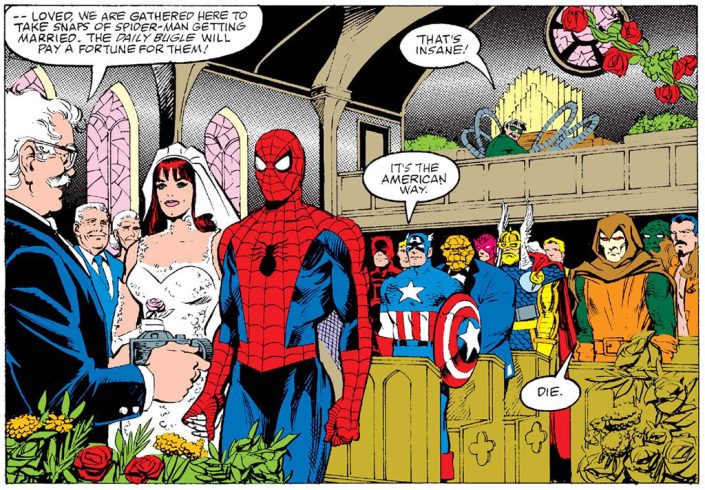
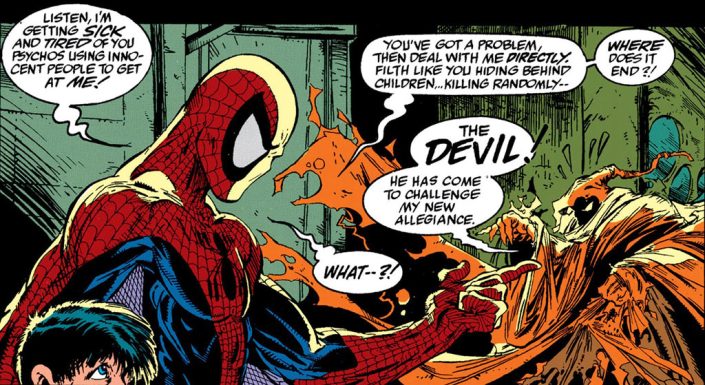
 Venom makes his debut in The Amazing Spider-Man #300, written by David Michelinie with art by Todd McFarlane. The character’s arrival establishes a major new presence in the series’ mythology and quickly occupies a notable space in both Spider-Man and wider Marvel continuity. Venom’s appearances can be followed in detail through our dedicated
 - Amazing Spider-Man Epic Collection: Venom
Collects Amazing Spider-Man #295-310 and Annual #22, Web Of Spider-Man (1985) #33, and Peter Parker, The Spectacular Spider-Man #133.- Web Of Spider-Man (1985) #34-38, available in Web of Spider-Man Omnibus Vol. 2
- The Spectacular Spider-Man: The Death of Jean Dewolff
Collects Peter Parker, The Spectacular Spider-Man #107-110 & #134-136. - The Spectacular Spider-Man: Tombstone
Collects Peter Parker, The Spectacular Spider-Man #137-150, and material from Annual #8.- Web Of Spider-Man (1985) #39-46, available in Web of Spider-Man Omnibus Vol. 2
- Amazing Spider-Man Epic Collection: Assassin Nation
Collects Amazing Spider-Man #311-325 and Annual #23 and Marvel Graphic Novel: Amazing Spider-Man — Parallel Lives.- Peter Parker, The Spectacular Spider-Man #151 to 157 have not been collected yet.
- Web Of Spider-Man (1985) #47-58, Annual #4, available in Web of Spider-Man Omnibus Vol. 2
- Amazing Spider-Man Epic Collection: Cosmic Adventures
Collects Amazing Spider-Man #326-333, Annual #24; Spectacular Spider-Man (vol. 2) #158-160, Annual #10; Web of Spider-Man #59-61, Annual #6.- Spider-Man appeared in Avengers #314-318, 329 collected in Spider-Man: Am I an Avenger?
- Marvel Comics Presents #48-50 featuring Spider-Man and Wolverine collected in Marvel Comics Presents Wolverine Vol. 2.
- Amazing Spider-Man #326-329; Spectacular Spider-Man #158-160; Web of Spider-Man (1985) #59-61, 64-65 are also collected in Acts Of Vengeance: Spider-Man & The X-Men.
- The Amazing Spider-Man: The Original Clone Saga
Collects Amazing Spider-Man #139-150; Peter Parker, The Spectacular Spider-Man (1976) #25-31, #149, #162-163 & Annual #8.
Spider-Man got cloned! It’s the 1990s
Spider-Man remained one of Marvel Comics’ most popular characters at the beginning of the 1990s, headlining several ongoing titles simultaneously, including The Amazing Spider-Man, Web of Spider-Man, and The Spectacular Spider-Man. During this period, Marvel further expanded the line with the launch of a fourth ongoing title, Spider-Man (1990), written and illustrated by Todd McFarlane following his run as an artist with David Michelinie on The Amazing Spider-Man. The era also marked a significant shift in Spider-Man’s mythology, with the continued rise of Venom, the introduction of Carnage, and more crossovers between the different Spider-Man titles.
- Amazing Spider-Man Epic Collection: Return of the Sinister Six
Collects Amazing Spider-Man #334-350, Spider-Man: Spirits of the Earth OGN.- Peter Parker, The Spectacular Spider-Man #164-177 are not collected yet.
- Web of Spider-Man #66-72, available in Web of Spider-Man Omnibus Vol. 2, but 73-76 have not been collected yet.
- Spider-Man: Deadly Foes of Spider-Man
Collects Deadly Foes of Spider-Man #1-4 and Lethal Foes of Spider-Man #1-4. - Spider-Man by Todd McFarlane Omnibus
Collects Spider-Man (1990) #1-14, 16, X-Force (1991) #4. - Infinity Gauntlet Omnibus
Collects Silver Surfer (1987) #34-38, 40, 44-60, Thanos Quest (1990) #1-2, Infinity Gauntlet #1-6, Cloak & Dagger (1988) #18, Spider-Man (1990) #17, Incredible Hulk (1968) #383-385, Doctor Strange, Sorcerer Supreme (1988) #31-36, Quasar (1989) #26-27, Sleepwalker (1991) #7. Check out our Infinity Saga Reading Order for more information.- Web of Spider-Man #77-80 have not been collected yet.
- Spider-Man: Revenge of the Sinister Six
Collects Spider-Man (1990) #15, 18-23.- Peter Parker, The Spectacular Spider-Man #178-185, available in Spectacular Spider-Man by DeMatteis & Buscema Omnibus.
- Web of Spider-Man #81-83 have not been collected yet.
- Amazing Spider-Man Epic Collection: Round Robin
Collects Amazing Spider-Man #351-360, Annual #25; Spectacular Spider-Man Annual #11; Web of Spider-Man Annual #7; Spider-Man: Fear Itself.- Web of Spider-Man #84-89 have not been collected yet.
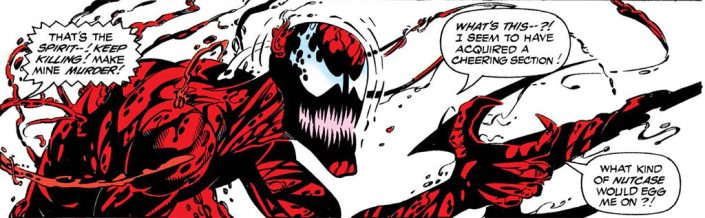
 Sixty issues after the introduction of Venom, Spider-Man’s mythology expanded again with the debut of another symbiote antagonist: Carnage. First appearing in The Amazing Spider-Man #361, written by David Michelinie with art by Mark Bagley, this offspring of the Venom symbiote bonded with serial killer Cletus Kasady. Carnage quickly became one of Spider-Man’s most dangerous enemies. His appearances can be followed in detail through a dedicated
 - The Amazing Spider-Man Epic Collection: The Hero Killers
Collects Amazing Spider-Man #361-367, Amazing Spider-Man Annual #26, Amazing Spider-Man: Soul of the Hunter #1; material from Spectacular Spider-Man Annual #12, Web of Spider-Man Annual #8, New Warriors Annual #2.- Carnage’s introduction is also available in Carnage Epic Collection: Born in Blood.
- Peter Parker, The Spectacular Spider-Man #186-190, available in Spectacular Spider-Man by DeMatteis & Buscema Omnibus.
- Web of Spider-Man #90-94 have not been collected yet.
- Spider-Man #26-34 are not collected yet.
- Infinity War Omnibus
Collects Infinity War #1-6, Fantastic Four (1961) #366-370, Spider-Man (1990) #24, Deathlok (1991) #16, Daredevil (1964) #310, Warlock And The Infinity Watch 7-10, Doctor Strange, Sorcerer Supreme 42-47, Silver Surfer (1987) #67-69, Wonder Man (1991) #13-15, Alpha Flight (1983) #110-112, Silver Sable & The Wild Pack 4-5, Guardians Of The Galaxy (1990) #27-29, Quasar 37-40, New Warriors (1990) #27, Marc Spector: Moon Knight 41-44, Nomad (1992) #7, Sleepwalker 18, Material From Captain America (1968) #408, Alpha Flight (1983) #109, Marvel Comics Presents (1988) #108-112. See the Infinity Saga Reading Order for more information. - Amazing Spider-Man Epic Collection: Invasion of the Spider-Slayers
Collects Amazing Spider-Man #368-377; Amazing Spider-Man Annual #27; Spider-Man/Dr. Strange: The Way to Dusty Death; Spider-Man Special Edition: The Trial of Venom. - Spirits of Venom
Collects Web of Spider-Man #95-96 and Ghost Rider Blaze Spirits of Vengeance #5-6. - Venom – Lethal Protector
Collects Venom – Lethal Protector #1-6.- Web Of Spider-Man #97-100, annual #9 are not collected yet.
- Peter Parker, The Spectacular Spider-Man #191-200, available in Spectacular Spider-Man by DeMatteis & Buscema Omnibus.
- Amazing Spider-Man Epic Collection: Maximum Carnage
Collects Amazing Spider-Man #378-380; Web of Spider-Man #101-103; Spider-Man #35-37; Spectacular Spider-Man #201-203; Spider-Man/Punisher/Sabretooth: Designer Genes and material from Spider-Man Unlimited #1-2.- Infinity Crusade Omnibus
Collects Infinity Crusade (1993) #1-6, Warlock Chronicles (1993) #1-5, Warlock And The Infinity Watch (1992) #18-22, Thor (1966) #463-467, Iron Man (1968) #294-295, Avengers West Coast (1989) #96-97, Darkhawk (1991) #30-31, Cage (1992) #17, Alpha Flight (1983) #124-125, 127, Marc Spector: Moon Knight (1989) #57, Silver Surfer (1987) #83-85, Deathlok (1991) #28, Material From Doctor Strange, Sorcerer Supreme (1988) #54-56, Alpha Flight (1983) #122-123, 126, Web Of Spider-Man (1985) #104-106, Silver Sable & The Wild Pack (1992) #16-17, Deathlok (1991) #29. See the Infinity Saga Reading Order for more information. - Web of Spider-Man #107-111 have not been collected yet.
- Peter Parker, The Spectacular Spider-Man #204-210, available in Spectacular Spider-Man by DeMatteis & Buscema Omnibus.
- Spider-Man #38-44 are not collected yet.
- Infinity Crusade Omnibus
- Amazing Spider-Man Epic Collection: Lifetheft
Collects Amazing Spider-Man (1963) #381-393, Amazing Spider-Man Annual (1964) #28, Spider-Man (1990) #45, Spectacular Spider-Man (1976) #211, Web of Spider-Man (1985) #112, Amazing Spider-Man Ashcan Edition (1994) #1.- Web of Spider-Man #113-116 have not been collected yet.
- Peter Parker, The Spectacular Spider-Man #212-215, available in Spectacular Spider-Man by DeMatteis & Buscema Omnibus.
- Spider-Man – The Arachnis Project #1-6 are not collected yet.
- Spider-Man #46-50 are not collected yet.
Spider-Man: The Clone Saga in Order!
The 1990s saw the Death of Superman, Batman getting his back broken, and Spider-Man getting cloned. This Clone Saga was obviously not the first one, the concept was introduced in the 1970s, a period collected in The Amazing Spider-Man: The Original Clone Saga, but the 1994–1997 storyline expanded the idea into a massive crossover spanning every Spider-Man title. In fact, it was so big that readers just wanted it to end at some point.
Developed by writers and editors including Terry Kavanagh, J.M. DeMatteis, Howard Mackie, Tom DeFalco, Danny Fingeroth, and others, the saga revolved around Peter Parker confronting resurrected enemies, genetic experiments, and multiple clones connected to his past. One of the clones was Ben Reilly, who returned after years in exile and eventually became a star of the Spider-Man line for a while. But was Ben really a clone or was Peter???
The Clone Saga affected all the titles: The Amazing Spider-Man, Spider-Man, Web of Spider-Man, and The Spectacular Spider-Man, but also numerous limited series, one-shots, and crossover events published between 1994 and 1997. Initially conceived as a shorter storyline revisiting older continuity, it ultimately became one of the largest and most divisive publishing periods in Spider-Man history. If you want to know more about it (and the issue-by-issue reading order), you can go to our Spider-Man: Clone Saga Reading Order.
- The Amazing Spider-Man Epic Collection: The Clone Saga
Collects Web Of Spider-Man (1985) #117-119, Amazing Spider-Man (1963) #394-396, Spider-Man (1990) #51-53, Spectacular Spider-Man (1976) #217-219, Spider-Man Unlimited (1993) #7 And Clone Subplot Pages.- Previously collected in Spider-Man: The Complete Clone Saga Epic Book 1
- The Amazing Spider-Man Epic Collection: Web of Life, Web of Death
Collects Web Of Spider-Man (1985) #120-123, Spider-Man (1990) #54-56, Amazing Spider-Man (1963) #397-399, Spectacular Spider-Man (1976) #220-222, Spider-Man Unlimited (1993) #8, Spider-Man: Funeral For An Octopus #1-3 and Spider-Man: The Clone Journal.- Previously collected in Spider-Man: The Complete Clone Saga Epic Book 2
- The Amazing Spider-Man Epic Collection: The Mark of Kaine [2026]
Collects Web of Spider-Man (1985) #124-126, Amazing Spider-Man (1963) #400-403, Spider-Man (1990) #57-60, Spectacular Spider-Man (1976) #223-226, Spider-Man Unlimited (1993) #9.- Previously collected in Spider-Man: The Complete Clone Saga Epic Book 3
- Spider-Man: The Complete Clone Saga Epic Book 4
Collects Amazing Spider-Man (1963) #402-404; Spectacular Spider-Man (1976) #225-227; Spider-Man (1990) #59-61; Web of Spider-Man #125-127; New Warriors (1990) #61; Spider-Man: The Jackal Files; Spider-Man: Maximum Clonage Alpha, Omega. - Spider-Man: The Complete Clone Saga Epic Book 5
Collects Amazing Spider-Man Super Special, Spider-Man Super Special, Venom Super Special, Spectacular Spider-Man Super Special, Web of Spider-Man Super Special, New Warriors (1990) #62, Web of Spider-Man #128-129, Amazing Spider-Man (1962) #405-406, Spider-Man (1990) #62-63, Spider-Man Unlimited (1993) #10, Spectacular Spider-Man (1976) #228-229, Spider-Man Team-Up #1, Spider-Man: The Parker Years.
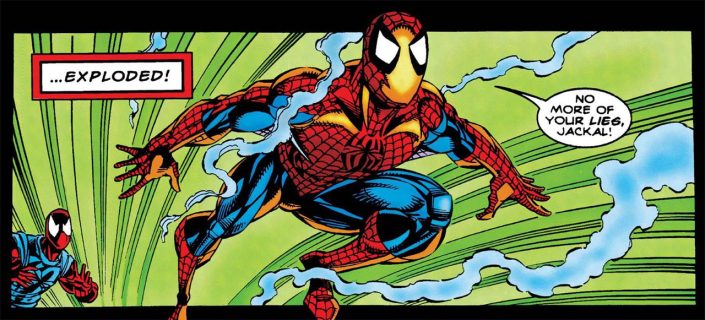
At that point, Peter Parker stepped away from his role as Spider-Man to begin a new life with Mary Jane Watson, who was then pregnant. With Peter retiring from superhero activity, Ben Reilly, who was previously fighting crime as the Scarlet Spider, assumed the mantle of Spider-Man, with a new costume and supporting cast.
- The Amazing Spider-Man – The Complete Ben Reilly Epic vol. 1
Collects Spider-Man: The Parker Years, New Warriors #65-66, Scarlet Spider Unlimited #1, Web Of Scarlet Spider #1-2, Amazing Scarlet Spider #1-2, Scarlet Spider #1-2, Spectacular Scarlet Spider #1-2, Green Goblin #3, and Sensational Spider-Man (1996) #0. - The Amazing Spider-Man – The Complete Ben Reilly Epic vol. 2
Collects Amazing Spider-Man #407-408, New Warriors #67, Sensational Spider-Man #1, Spectacular Spider-Man #230, Spider-Man #64-65, Spider-Man/Punisher: Family Plot #1-2, Web Of Scarlet Spider #3-4, and material from Spider-Man Holiday Special and Venom: Along Came A Spider #1-4. - The Amazing Spider-Man – The Complete Ben Reilly Epic vol. 3
Collects Amazing Spider-Man #409-410, Sensational Spider-Man #2-3, Spectacular Spider-Man #231-233, Spider-Man #66-67, Spider-Man: The Final Adventure #1-4, Spider-Man Team-Up #2, and Spider-Man Unlimited #11. - Spider-Man: The Lost Hunt
Collects Spider-Man: The Lost Hunt #1-5. A 2022 story written by J.M. Dematteis set after Spider-Man: The Final Adventure. - The Amazing Spider-Man – The Complete Ben Reilly Epic vol. 4
Collects Amazing Spider-Man #411-413, Daredevil #354, Sensational Spider-Man #4-6, Spectacular Spider-Man #234, Spider-Man #68-70, Spider-Man: Redemption #1-4, Spider-Man Team-Up #3, and Spider-Man Unlimited #12. - The Amazing Spider-Man – The Complete Ben Reilly Epic vol. 5
Collects Amazing Spider-Man #414-416, Sensational Spider-Man #7-10, Spectacular Spider-Man #235-239, Spider-Man #71-72, Spider-Man Team-Up #4, Spider-Man Unlimited #13, and material from Amazing Spider-Man Annual ’96. - This is when you’re supposed to read the X-Men: Onslaught event.
- The Amazing Spider-Man – The Complete Ben Reilly Epic vol. 6
Collects Amazing Spider-Man #417-418, Sensational Spider-Man #11, Spectacular Spider-Man #240-241, Spider-Man #73-75, Spider-Man Team-Up #5, Spider-Man Unlimited #14, Spider-Man: 101 Ways To End The Clone Saga, and material from Spider-Man: Revelations & Spider-Man: The Osborn Journal.
Peter Parker’s Back in Action!
Even if the Clone Saga went on for much longer than anyone could have expected, Peter Parker was deemed to come back eventually. He has become Spider-Man again. We are in the second half of the 1990s, writers like J. M. DeMatteis, Tom DeFalco, Howard Mackie, and Todd Dezago, with artists such as Joe Bennett, Luke Ross, Steve Skroce, John Romita Jr., Mike Wieringo, and others, refocused on Peter Parker’s personal life, supporting cast, and rogues’ gallery, going back to a more conventional publishing approach.
- The Sensational Spider-Man: The Savage Land Saga
Collects The Sensational Spider-Man #13-15. - Spider-Man: Hobgoblin Lives
Collects Spider-Man: Hobgoblin Lives #1-3, (Peter Parker, The Spectacular Spider-Man #259-261 to be read later). - X-Man: Dance with the Devil
Collects X-Man #20-29 and Annual ’96, and Amazing Spider-Man #420. - Spider-Man #76-87, Annual 1997 have not been collected yet.
- Peter Parker, The Spectacular Spider-Man #242-250 have not been collected yet.
- Spider-Man Unlimited #15-18 have not been collected yet.
- Amazing Spider-Man #421-429 have not been collected yet.
- Spider-Man By Todd Dezago and Mike Wieringo
Collects The Sensational Spider-Man #7-24, -1. - Venom: Tooth And Claw
Collects Venom: Tooth And Claw #1-3, Venom: On Trial #1-3, Venom: License To Kill #1-3, Venom: Seed Of Darkness #-1, Venom: Sign Of The Boss #1-2, Spider-Man: The Venom Agenda And Venom: The Finale #1-3. - Peter Parker, The Spectacular Spider-Man #251-254 have not been collected yet.
- Carnage Classic
Collects Amazing Spider-Man (1963) 361-363, 410, 430-431; Venom: Carnage Unleashed 1-4; Carnage: Mind Bomb; Carnage: It’s A Wonderful Life; Sensational Spider-Man (1996) 3; Spider-Man (1990) 67; Spectacular Spider-Man (1976) 233; Peter Parker: Spider-Man (1999) 13; Webspinners: Tales Of Spider-Man 13-14. - Spider-Man Spider Hunt
Collects Sensational Spider-Man (1996) #25-26, Amazing Spider-Man #432-433, Spider-Man #88-90, and Spectacular Spider-Man #254-256. - Spider-Man: Identity Crisis
Collects Spider-Man #91-92, Spectacular Spider-Man #257-258, Sensational Spider-Man #27-28, and Amazing Spider-Man #434-435. - Spider-Man Unlimited #19-21 have not been collected yet.
- Sensational Spider-Man #29-31 have not been collected yet.
- Spider-Man: Hobgoblin Lives
Collects (Spider-Man: Hobgoblin Lives #1-3 to be read earlier), Peter Parker, The Spectacular Spider-Man #259-261. - Amazing Spider-Man #436-439 have not been collected yet.
- Spider-Man: The Gathering of Five
Collects Amazing Spider-Man #440-441, Spider-Man #96-98, Sensational Spider-Man #32-33, Spectacular Spider-Man #262-263.
The “New” Amazing Spider-Man
With issue #440, The Amazing Spider-Man concluded its first Volume before being immediately relaunched as a new volume, written by Howard Mackie with art by John Byrne. In parallel, the series Peter Parker: Spider-Man (originally launched simply as Spider-Man) was also written by Howard Mackie, but with John Romita Jr. handling artwork. The Sensational Spider-Man and Peter Parker, The Spectacular Spider-Man had concluded, respectively, with issues #33 and #263.
- Spider-Man: The Next Chapter Vol. 1: The Next Chapter – Volume 1
Collects Amazing Spider-Man (1999) #1-6 and Annual ’99, Peter Parker: Spider-Man (1999) #1-6, and Thor (1998) #8.- Marvel Knights Daredevil by Bendis, Jenkins, Gale & Mack: Unusual Suspects
Collects Daredevil: Ninja #1-3, Daredevil/Spider-Man #1-4, Daredevil (1998) #20-25, and #51-55, and Spider-Man/Daredevil #1.
- Marvel Knights Daredevil by Bendis, Jenkins, Gale & Mack: Unusual Suspects
- Spider-Man: The Next Chapter Vol. 2: The Next Chapter Volume 2
Collects Amazing Spider-Man (1999) #7-12, and Peter Parker: Spider-Man (1999) #7-12 and Annual ’99.- Peter Parker: Spider-Man #11 is part of “The Eight Day” storyline (The Invincible Iron Man v3 #21, The Mighty Thor v2 #17, Invincible IM v3 #22, Peter Parker Spider-Man v2 #11, and Juggernaut – The Eighth Day #1).
- Spider-Man: The Next Chapter Vol. 3: The Next Chapter – Volume 3
Collects Amazing Spider-Man (1999) #13-19 And Annual 2000, Peter Parker: Spider-Man (1999) #13-19, and Spider-Woman (1999) #9. The new Spider-Woman series was launched by John Byrne a bit earlier, see Jessica Drew Reading Order. - Peter Parker Spider-Man Vol. 1: A Day in the Life
Collects Peter Parker: Spider-Man #20-22, 26, and Webspinners #10-12. - Spider-Man: Revenge of the Green Goblin
Collects Amazing Spider-Man (1999) #20-29 and Annual 2001, Spider-Man: Revenge of the Green Goblin #1-3, and Peter Parker: Spider-Man (1999) #25 and #29.- Amazing Spider-Man (1999) #24 and Peter Parker Spider-Man (1999) #24 are part of the Maximum Security crossover event.
- Spider-Man/Black Cat: Evil That Men Do
Collects Spider-Man/Black Cat: Evil That Men Do #1-6.
✨The Amazing Spider-Man by J. Michael Straczynski: From Coming Home to One More Day
Starting with The Amazing Spider-Man (1999) #30, J. Michael Straczynski became the main writer of the series, working with artist John Romita Jr., effectively defining Spider-Man’s direction for the early 2000s. His run is widely regarded as one of the most influential modern runs on the flagship Spider-Man series, though its later part was significantly derailed by Marvel Comics editorial, resulting in a controversial and widely debated conclusion. You can focus on Straczynski’s work if you only want the essentials. Go to our guide to read the Spider-Man by J. Michael Straczynski Reading Order for more information.
During this period, Spider-Man’s publishing line didn’t shrink, with multiple concurrent titles including Peter Parker: Spider-Man (later replaced by The Spectacular Spider-Man Vol. 2), Spider-Man’s Tangled Web, and Venom, the latter of which occasionally connected with The Amazing Spider-Man.
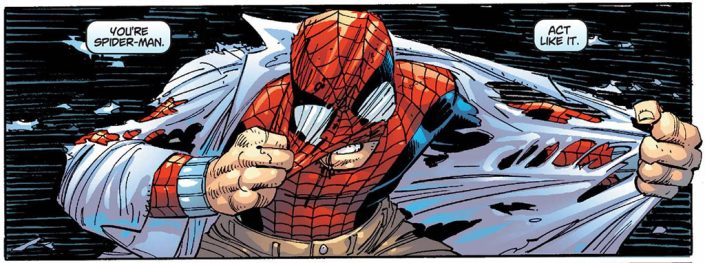
So, for a more detailed version of the listing of Straczynski’s Amazing Spider-Man comics in order, we are still mainly using the old collection for now:
- Amazing Spider-Man vol. 1: Coming Home
Collects Amazing Spider-Man (1999) #30-35. - Peter Parker: Spider-Man vol. 2: One Small Break
Collects Peter Parker: Spider-Man (1999) #27–28, 30–34. - Spider-Man/Black Cat: The Evil That Men Do
Collects Spider-Man/Black Cat: Evil That Men Do #1-6. To know more about this miniseries and Black Cat, go to our Black Cat Reading Order. - Amazing Spider-Man vol. 2: Revelations
Collects Amazing Spider-Man (1999) #36-39. - Infinity Abyss
Collects Infinity Abyss 1-6. A miniseries written by Jim Starlin about Thanos in which Spider-Man teams up with Doctor Strange, Adam Warlock, Pip the Troll, and Captain Marvel. - Peter Parker: Spider-Man vol. 3: Return of the Goblin
Collects Peter Parker: Spider-Man (1999) #44-47. - Peter Parker: Spider-Man vol. 4: Trials & Tribulations
Collects Peter Parker: Spider-Man (1999) #48-50; 35, 37. - Venom Vol. 3: Twist
Collects Venom (2003) #14-18. - Peter Parker: Spider-Man vol. 5: Senseless Violence
Collects Peter Parker: Spider-Man (1999) #51-57. - Amazing Spider-Man vol. 3: Until the Stars Turn Cold
Collects Amazing Spider-Man (1999) #40-45. - Amazing Spider-Man vol. 4: The Life and Death of Spiders
Collects Amazing Spider-Man (1999) #46-50. - The Spectacular Spider-Man Vol. 1: The Hunger
Collects The Spectacular Spider-Man (vol. 2) #1–5. - Amazing Spider-Man vol. 5: Unintended Consequences
Collects Amazing Spider-Man (1999) #51-56. - The Spectacular Spider-Man Vol. 2: Countdown
Collects The Spectacular Spider-Man (vol. 2) #6–10. - Venom vs. Carnage
Collects Venom vs Carnage (2004) #1-4. - Amazing Spider-Man vol. 6: Happy Birthday
Collects Amazing Spider-Man (1999) #57-58, 500-502. - Amazing Spider-Man vol. 7: The Book of Ezekiel
Collects Amazing Spider-Man (1999) #503-508. - The Spectacular Spider-Man Vol. 3: Here There Be Monsters
Collects Spectacular Spider-Man (2003) #11-14. - The Pulse Vol. 1: Thin Air
Collects Pulse (2004) #1-5. - Amazing Spider-Man vol. 8: Sins Past
Collects Amazing Spider-Man (1999) #509-514.
 Marvel Knights Spider-Man was meant to replace the cancelled Spider-Man’s Tangled Web. Sold as the Spidey series with a more mature tone, the series was initially done by Mark Millar and Terry Dodson. After the first year, Reginald Hudlin and Billy Tan took over. After 22 issues, when Marvel decided to redefine its
 - Spider-Man by Mark Millar Ultimate Collection (aka Marvel Knights Spider-Man)
Collects Marvel Knights Spider-Man #1-12. - The Spectacular Spider-Man Vol. 4: Disassembled
Collects Spectacular Spider-Man (2003) #15-20.
 Following the events of Avengers Disassembled, written by Brian Michael Bendis, the Avengers formally disbanded after a series of catastrophic internal crises that reshaped the team’s status quo (check the
 - New Avengers Modern Era Epic Collection: Assembled
Collecting Avengers (1998) #500-503 And #500 Director’s Cut, Avengers Finale, New Avengers (2004) #1-10 And #1 Director’s Cut, And New Avengers: Most Wanted Files. - Spider-Man: Breakout
Collects Spider-Man: Breakout #1-5. - The Spectacular Spider-Man Vol. 5: Sins Remembered
Collects Spectacular Spider-Man (2003) #23–26 - The Spectacular Spider-Man Vol. 6: The Final Curtain
Collects Spectacular Spider-Man (2003) #21-22, 27. - Amazing Spider-Man vol. 9: Skin Deep
Collects Amazing Spider-Man (1999) #515-518. - Amazing Spider-Man vol. 10: New Avengers
Collects Amazing Spider-Man (1999) #519-524. - Marvel Knights Spider-Man Vol. 4: Wild Blue Yonder
Collects Marvel Knights Spider-Man #13-18.
 We are beginning the era of almost continuous crossover events. House of M is the first, and you can check out our
 - House of M: Spider-Man
Collects Spider-Man: House of M #1-5. - New Avengers (2004) #11-15, available in New Avengers Modern Era Epic Collection: Civil War.
- Toxin
Collects Toxin (2005) #1-6. - Beyond!
Collects Beyond! (2006) #1-6. - Spider-Man: The Other [2026 printing]
Collects Friendly Neighborhood Spider-Man #1-4, Marvel Knights Spider-Man #19-22, & Amazing Spider-Man #525-528. - Sensational Spider-Man: Feral
Collects The Sensational Spider-Man #23-27.
 Working as a spiritual replacement of The Spectacular Spider-Man, Friendly Neighborhood Spider-Man came from Peter David and Mike Wieringo. Launched with the crossover “The Other,” it tells stories parallel to the main series, notably dealing with the changes introduced during Civil War.
- Friendly Neighborhood Spider-Man Vol. 1: Derailed
Collects Friendly Neighborhood Spider-Man #5-10. - The New Avengers #16-20, available in New Avengers Modern Era Epic Collection: Civil War.
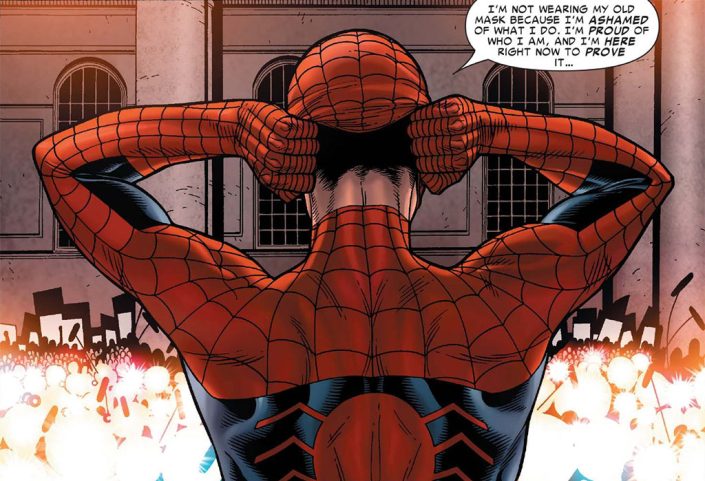
 Civil War! Peter travels with Tony Stark to Washington, D.C., and the White House, where the enactment of the Super Hero Registration Act appears imminent. As the Marvel Comic Book Universe braces for the implications of legislation that will forever change the societal status of superheroes, Peter is forced to make an important personal decision, maybe the most important decision of his life. As Civil War tears apart the superhero community, will Spidey stay true to that decision? It’s time to check the guide to read the
 - Civil War: The Road to Civil War
Collects Fantastic Four (1997) #536-537, New Avengers: Illuminati One-Shot, Amazing Spider-Man (1999) #529-531. - Civil War
Collects Civil War (2006) #1-7 - Civil War: Amazing Spider-Man
Collects Amazing Spider-Man #532-538. - Civil War: Peter Parker, Spider-Man
Collects The Sensational Spider-Man #28-34. - The New Avengers #21-25, available in New Avengers Modern Era Epic Collection: Civil War.
- The New Avengers #26-37, Annual #2, available in New Avengers Modern Era Epic Collection: The Initiative.
- Amazing Spider-Man Vol. 12: Back in Black
Collects Amazing Spider-Man (1999) #539-543, Friendly Neighborhood Spider-Man (2005) #17-23, and Annual #1. - Spider-Man: One More Day
Collects Amazing Spider-Man #544-545, Friendly Neighborhood Spider-Man #24, Sensational Spider-Man #41. Now available in a hardcover gallery edition.
Spider-Man: Brand New Day & The Gauntlet
Following the controversial events of One More Day, which concluded J. Michael Straczynski’s run on The Amazing Spider-Man, Marvel Comics relaunched the entire Spider-Man line around a single flagship title. The Amazing Spider-Man was published three times per month, produced by a rotating team of writers and artists under a coordinated editorial approach. The relaunch began with the “Brand New Day” era, conceived as a back-to-basics reset that re-established Peter Parker as a younger, single, and more grounded character while introducing new supporting cast members and villains, paving the way for Dan Slott to emerge as the principal long-term writer of Spider-Man throughout the following decade.
- Spider-Man: Brand New Day — The Complete Collection Vol. 1
Collects Amazing Spider-Man (1963) #546-564 and material from Spider-Man: Swing Shift Director’s Cut. - Spider-Man: Brand New Day — The Complete Collection Vol. 2
Collects Amazing Spider-Man (1963) #565-577, Amazing Spider-Man Annual (2008) #1, Secret Invasion: Amazing Spider-Man #1-3, and material from Amazing Spider-Man: Extra! #1.
 The Secret Invasion event took place at that time: a brutal battle between the New Avengers and the Hand, one that claimed the life of Elektra and revealed that she was a Skrull! It’s not a Spider-Man essential. Go check out our
 - Spider-Man: Brand New Day — The Complete Collection Vol. 3
Collects Amazing Spider-Man (1999) #578-591, Spider-Man: Presidents’ Day Special, Spider-Man: Fear Itself (2009) #1, Amazing Spider-Man: Extra #2-3, and material from #1.
 After Secret Invasion came the Dark Reign, a new “dark” era for the heroes of the Marvel Comics Universe. Dark Reign is not an event, but a thematic era (
- Spider-Man: Brand New Day — The Complete Collection Vol. 4
Collects Amazing Spider-Man (1999) #592-601 and Annual #36, Spider-Man: The Short Halloween, Dark Reign: Mister Negative #1-3, Amazing Spider-Man: American Son Sketchbook, and material from Amazing Spider-Man Family #7. - Spider-Man: Red-Headed Stranger
Collects The Amazing Spider-Man #602-605. - Spider-Man: Return of the Black Cat
Collects The Amazing Spider-Man #606-611 and material from Web of Spider-Man #1.
 Siege! It’s the end of the Dark Reign Era. Coerced by Loki and on the brink of madness, Osborn, in his final bid to take total control, targets the final obstacle in his mission…Asgard.
 - Spider-Man: The Gauntlet – The Complete Collection Vol. 1
Collects Dark Reign: The List — Amazing Spider-Man, Amazing Spider-Man (1999) #612-626 and Annual #37, and material from Web Of Spider-Man (2009) #2-5. - Spider-Man: The Gauntlet – The Complete Collection Vol. 2
Collects Amazing Spider-Man (1999) #627-637, Grim Hunt: The Kraven Saga (2010) #1, Amazing Spider-Man Presents: Black Cat (2010) #1-4, material from Web of Spider-Man (2009) #6-7. - Amazing Spider-Man Presents – American Son – a 4-issue miniseries about Harry dealing with the truth about his father.
- Spider-Man: One Moment in Time
Collects Amazing Spider-Man (1999) #638-641. - Web of Spider-Man (vol. 2) #7-11 are collected in Spider-Man: New York Stories.
- Spider-Man: Origin of the Species
Collects Amazing Spider-Man (1999) #642-647; Spider-Man Saga; Web of Spider-Man (vol. 2) #12.
 New York Event! In Shadowland, Spider-Man, Luke Cage, Iron Fist, Punisher, and more join forces to stop a war that is breaking out throughout New York, with Daredevil at the center. See the
The Amazing Spider-Man Comics by Dan Slott
After contributing to the rotating creative team during the “Brand New Day” initiative, Dan Slott became the sole writer of The Amazing Spider-Man with issue #648, launching the “Big Time” era alongside artist Humberto Ramos. This is the beginning of what became the longest continuous run by a writer in Spider-Man history. Over the course of his tenure, Slott introduced major additions to Spider-Man’s mythology, including new characters and concepts, significant updates to classic villains and supporting cast members, the multiversal “Spider-Verse” storyline, and the status quo-changing Superior Spider-Man, in which Doctor Octopus temporarily replaced Peter Parker as Spider-Man.
Slott remained the principal architect of the Spider-Man line until 2018, concluding his run with The Amazing Spider-Man #801. Despite leaving The Amazing Spider-Man, he later returned to write additional Spider-Man-related projects and further expansions of the Spider-Verse concept. More information about this period, including its many collected editions, can be found in our The Amazing Spider-Man by Dan Slott Reading Order
- The Amazing Spider-Man Modern Era Epic Collection: Big Time
Collects Amazing Spider-Man #649-662, #654.1, and material from #648.
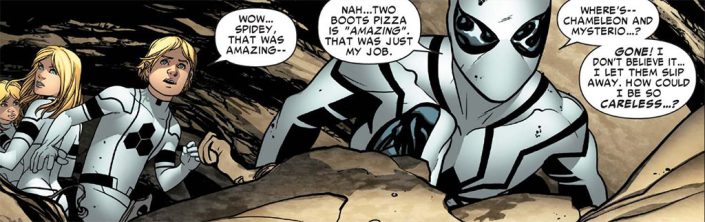
 Spider-Man joined The Future Foundation (aka F4) just after #657 in Fantastic Four #588 & FF #1. This is Jonathan Hickman’s era (see our guide to the
 - Fantastic Four by Jonathan Hickman: The Complete Collection Vol. 2
Collects Fantastic Four (1998) #579-588 & FF (2011) #1-5. - Fantastic Four by Jonathan Hickman: The Complete Collection Vol. 3
Collects FF (2011) #6-16, Fantastic Four (1998) #600-604. - Avengers by Brian Michael Bendis: The Complete Collection Vol. 1
Collects Avengers Prime #1-5, Avengers (2010) #1-12 and Annual (2012) #1, and New Avengers Annual (2011) #1. - New Avengers by Brian Michael Bendis: The Complete Collection Vol. 6
Collects New Avengers (2010) #1-16.
 Be afraid of Fear Itself! The entire planet has been seized by Fear, and only chaos reigns. The Serpent, Asgard’s most ancient evil, has awakened and is feeding off the fear of Earth’s populace. Don’t be afraid,
 - Fear Itself
Collects Fear Itself: Book of the Skull, Fear Itself 1-7. - Fear Itself: Spider-Man
Collects Fear Itself: Spider-Man #1-3, Fear Itself: The Worthy #1, and Fear Itself: FF #1. - New Avengers By Brian Michael Bendis Vol. 3
Collects New Avengers #16.1 & 17-23. - Spider-Man: The Return of Anti-Venom
Collects Amazing Spider-Man issues #663–665.
- The Amazing Spider-Man Modern Era Epic Collection: Spider-Island [2026]
Collects Amazing Spider-Man (1999) #663-676, Amazing Spider-Man: Infested (2011), Free Comic Book Day 2011 (Spider-Man), and Spider-Island: Deadly Foes (2011). - The “Devil and the Details” two-part crossover (Amazing Spider-Man issues #677 & Daredevil #8) is available in Spider-Man: Flying Blind.
- Carnage U.S.A
Collects Carnage U.S.A. #1-5.
🕸️Writer Zeb Wells and artist Joe Madureira launched Avenging Spider-Man, a team-up series featuring Spider-Man alongside a rotating cast of Marvel heroes.
- Avenging Spider-Man: The Complete Collection Vol. 1
Collects Avenging Spider-Man #1-15 And Annual #1, Punisher (2011) #10, Daredevil (2011) #11, Amazing Spider-Man Annual #39, Spider-Man Vs. Vampires #1 And Material From Amazing Spider-Man (1999) #692. - Spider-Man: Trouble on the Horizon
Collects Amazing Spider-Man issues #678–681 & 679.1 - Spider-Man: Ends of the Earth
Collects Amazing Spider-Man issues #682–687, Ends of the Earth #1, and Avenging Spider-Man #8.
 The Avengers and the X-Men go to war in Avengers vs. X-Men! This 2012 crossover comics event involved the return of the Phoenix Force and the subsequent war between the Avengers and the X-Men. For a more comprehensive look at the event,
 - Avengers: X-Sanction
Collects Avengers: X-Sanction #1-4. - Avengers vs. X-Men
Collects Avengers vs. X-Men #0–12, Material from Marvel Point One. - New Avengers by Brian Michael Bendis Volume 4
Collects New Avengers #24–30.
 Courtesy of Mysterio’s multiversal manipulation, the Marvel Universe’s Peter Parker encounters
 - Spider-Men
Collects Spider-Men #1-5. Also collected in Spider-Men: Worlds Collide. - Spider-Man: Lizard – No Turning Back
Collects Amazing Spider-Man issues #688–691 and Untold Tales of Spider-Man #9. - Spider-Man: Danger Zone
Collects Amazing Spider-Man issues #692–697, and Avenging Spider-Man #11. - New Avengers By Brian Michael Bendis Vol. 5
Collects New Avengers #31-34. - New Avengers Vol. 1: Everything Dies
Collects New Avengers (2013) #1-6.
The Superior Spider-Man Comics Era by Dan Slott
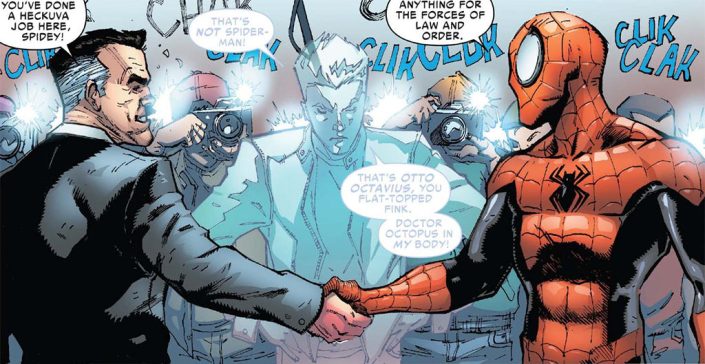
At this point, it is hardly a spoiler anymore: Spider-Man is no longer “Amazing,” but Superior. Following the conclusion of Dan Slott’s “Dying Wish” storyline, in issue #700, Peter Parker seemingly dies after Doctor Octopus transfers his mind into Peter’s body, leaving Otto Octavius in control as the new Spider-Man. Convinced he can become a better hero than Peter ever was, Otto adopts the identity of the “Superior Spider-Man,” and imposes his own approach to crime-fighting. If you are looking for a more focused look at this Superior version of Spidey (going beyond this era), check out our Superior Spider-Man Reading Order.
- Spider-Man: Dying Wish
Collects Amazing Spider-Man #698–700 - Superior Spider-Man Vol. 1: My Own Worst Enemy
Collects Superior Spider-Man #1–5. - Avengers Vol. 2: The Last White Event
Collects Avengers (2012) #7-11. - Age of Ultron
Collects Avengers (2010) #12.1 and Age of Ultron #1-10. Go to the reading order to know more about this miniseries. The tie-in issue “Superior Spider-Man #6.AU” is collected in Age of Ultron Companion. - Superior Spider-Man Vol. 2: A Troubled Mind
Collects Superior Spider-Man #6-10. - Superior Spider-Man Vol. 3: No Escape
Collects Superior Spider-Man #11-16. - Superior Spider-Man Vol. 4: Necessary Evil
Collects Superior Spider-Man #17-21. - Alpha: Big Time
Collects Alpha: Big Time #1-5. - Avengers Vol. 3: Prelude to Infinity
Collects: Avengers (2012) #12-17. - Mighty Avengers Vol. 1: No Single Hero
Collects Mighty Avengers (2013) #1-3, 4.INH-5.INH. Ties into Infinity, see reading order here. - The Superior Spider-Man Companion
Collects Avenging Spider-Man 15.1, 16-22; Daredevil (2011) 22; Superior Spider-Man Team-Up 1-12; Scarlet Spider (2012) 20; and Inhumanity: Superior Spider-Man 1. Superior Spider-Man Team-Up #3-4 are tied to the Infinity crossover. - Superior Spider-Man Vol. 5: Superior Venom
Collects Superior Spider-Man #22-26 & Annual 1. - Inhumanity
Collects Avengers Assemble #21.INH-23. INH ; Inhumanity #1-2; Uncanny X-Men #15.INH; Indestructible Hulk #17.INH-18.INH, 19; New Avengers #13.INH; Iron Man #20.INH ; Inhumanity: The Awakening #1-2; Avengers A.I. #7.INH ; Mighty Avengers #4.INH-5.INH; Inhumanity: Superior Spider-Man. Check out our Infinity/Inhumanity Reading Order to see how to read those comics. - Superior Carnage
Collects Superior Carnage #1-5. - Superior Spider-Man Vol. 6: Goblin Nation
Collects Superior Spider-Man #27-31 & Annual 2.
The Amazing Spider-Man is back in Action
Following the conclusion of the Superior Spider-Man era, The Amazing Spider-Man resumed with Peter Parker restored to his body and once again operating as Spider-Man. This period focused on rebuilding Peter’s life, but is also notable for the introduction of Cindy Moon, later known as Silk, a new spider-powered character connected to Peter Parker’s original radioactive spider origin, and who quickly became an important part of the expanding Spider-Man mythos. Most of all, this is when the famous Spider-Verse crossover event took place.
- Amazing Spider-Man Vol. 1: The Parker Luck
Collects Amazing Spider-Man (2014) #1–6. Issues #4 & 5 take place during the Original Sin event. - The Amazing Spider-Man: Family Business (OGN)
- Amazing Spider-Man Vol. 1.1: Learning to Crawl
Collects Amazing Spider-Man #1.1-1.5.
 It’s time to enter the Spider-Verse! When the evil Inheritors begin exterminating spider characters throughout the multiverse, every single Spider-Man ever is needed to save the day! You can find a lot more information by reading all of the
 - Amazing Spider-Man Vol. 2: Spider-Verse Prelude
Collects Amazing Spider-Man (2014) #7-8 & Superior Spider-Man #32-33. - Amazing Spider-Man Vol. 3: Spider-Verse
Collects Amazing Spider-Man (2014) #9-15. - Amazing Spider-Man Vol. 4: Graveyard Shift
Collects Amazing Spider-Man (2014) #16-18, Amazing Spider-Man Annual (2014) #1. - Amazing Spider-Man Vol. 5: Spiral
Collects Amazing Spider-Man (2014) #16.1-20.1.
 After being introduced on the road to the Spider-Verse event (her first appearance was in The Parker Luck), Cindy Moon (aka Silk) went on to have her own adventures in her ongoing comic book series featuring J. Jonah Jameson. You can learn more about her in our reading guide for the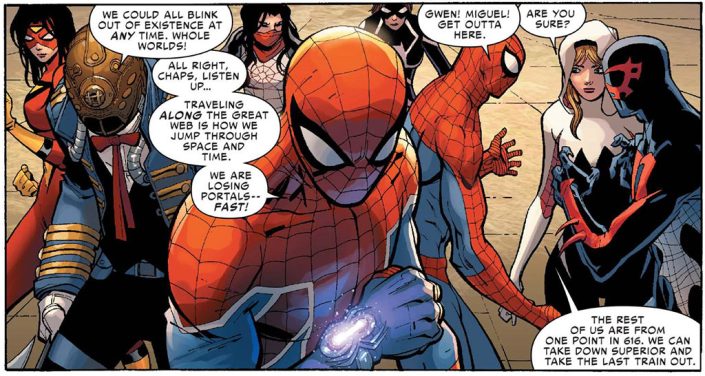
 In 2015, Marvel Comics published the Secret Wars event (check out the
 The Amazing Spider-Man: Worldwide Comics by Dan Slott
The Amazing Spider-Man was relaunched once again as part of Marvel’s post-Secret Wars publishing initiative, ushering in the “Worldwide” era of Dan Slott’s run. In this new status quo, Peter Parker transformed Parker Industries into a global technology company with offices in cities such as New York, Shanghai, London, and San Francisco, while Spider-Man operated on an international scale alongside him as his public “bodyguard.” The series significantly expanded Spider-Man’s scope beyond his traditional street-level setting, introducing globe-spanning conflicts involving a revitalized Zodiac organization and other large-scale threats.
This period also coincided with the expansion of the wider Spider-Man line, including relaunches for Silk, Spider-Man 2099, and Spider-Woman, while Miles Morales was permanently integrated into the primary Earth-616 Marvel Universe.
- Amazing Spider-Man: Worldwide, Vol. 1
Collects Amazing Spider-Man (2016) #1-5. - The Amazing Spider-Man: Amazing Grace
Collects Amazing Spider-Man (2016) #1.1-1.6. - Amazing Spider-Man & Silk: The Spider(fly) Effect
Collects Amazing Spider-Man & Silk: The Spider(fly) Effect #1-4.
 A new team-up comics series was launched: Spider-Man/Deadpool. It wasn’t supposed to last long, but it was a success. In parallel to the main Amazing Spider-Man comics,
 - Spider-Man/Deadpool Vol. 1: Isn’t It Bromantic
Collects Spider-Man/Deadpool #1–5, 8.
🕸️Mary-Jane started working for Tony Stark, and this led your friendly neighborhood Spider-Man to team up with Iron Man.
- Invincible Iron Man Vol. 2: The War Machines
Collects Invincible Iron Man Vol. 2 #6-11. - Amazing Spider-Man: Worldwide, Vol. 2
Collects Amazing Spider-Man (2016) #6-11. - Spider-Man/Deadpool Vol. 2: Side Pieces
Collects Spider-Man/Deadpool #1.MU, 6–7, 11–12. - Amazing Spider-Man: Worldwide, Vol. 3
Collects Amazing Spider-Man (2016) #12-15.
 Iron Man vs Captain Marvel, it’s
 - Civil War II
Collects Civil War II 0–8, Free Comic Book Day 2016. - Civil War II: Amazing Spider-Man
Collects Civil War II: Amazing Spider-Man 1-4, Material From Amazing Spider-Man (2014) 7-8. - Civil War II: Kingpin
Collects Civil War II: Kingpin 1-4, Amazing Spider-Man (1963) #51. - Spider-Man/Deadpool Vol. 3: Itsy Bitsy
Collects Spider-Man/Deadpool #9–10, 13–14, 17–18. - Avengers: Unleashed Vol. 1: Kang War One
Collects Avengers (2016) #1-6. - Deadpool: World’s Greatest Volume 8: Til Death Do Us
Collects Deadpool: World’s Greatest #28–29, Deadpool & The Mercs for Money #9-10, Spider-Man/Deadpool #15-16. - Amazing Spider-Man: Worldwide, Vol. 4
Collects Amazing Spider-Man (2016) #16-18 & Annual 1.
- Amazing Spider-Man: Worldwide, Vol. 5
Collects Amazing Spider-Man (2016) #19-24. Also collected in The Clone Conspiracy book. - Amazing Spider-Man: Worldwide Vol. 6
Collects Amazing Spider-Man (2016) #25-28. - Spider-Men II
Collects Spider-Men II #1-5. Also collected in Spider-men: Worlds Collide.
 A new Spectacular Spider-Man comic series written by Chip Zdarsky with art by Adam Kubert was launched. In this series, the relationship between Peter Parker and J.J. Jameson changed a lot, and it’s not really explained in Amazing Spider-Man. After 6 issues, the book adopted the legacy numbering, with issue #297.
- Peter Parker: The Spectacular Spider-Man Vol. 1: Into The Twilight
Collects Peter Parker: The Spectacular Spider-Man (2017) #1-6 and material from Free Comic Book Day 2017 (Secret Empire) #1. - Spider-Man/Deadpool Vol. 4: Serious Business
Collects Spider-Man/Deadpool #19–22.
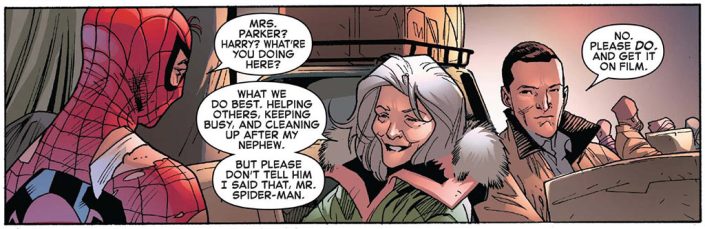
 The Secret Empire took over. The Cosmic Cube has remade Captain America into a secret true believer in the cause of Hydra! Now, using the trust and respect he’s been accorded by the great powers of the Marvel Universe, Steve Rogers makes Hydra’s ideals a reality! Our
 - Secret Empire
Collects Secret Empire #0-9, Free Comic Book Day 2017 Defenders #1 - Amazing Spider-Man: Worldwide, Vol. 7
Collects Amazing Spider-Man (2016) #29-32, #789-791. (#29-31 are part of the Secret Empire event) - Spider-Man/Deadpool Vol. 5: Arms Race
Collects Spider-Man/Deadpool #23-28. - Amazing Spider-Man: Venom Inc.
Collects Amazing Spider-Man: Venom Inc. Alpha 1, Amazing Spider-Man (2016) #792-793, Venom #159-160, Amazing Spider-Man: Venom Inc. Omega 1. - Peter Parker: The Spectacular Spider-Man Vol. 2: Most Wanted
Collects Peter Parker: The Spectacular Spider-Man (2017) #297-300. - Peter Parker: The Spectacular Spider-Man Vol. 3: Amazing Fantasy
Collects Peter Parker: The Spectacular Spider-Man (2017) #301-303 and Annual #1. Don’t read Annual #1 here, see after Amazing Spider-Man: Worldwide Vol. 9 - Peter Parker: The Spectacular Spider-Man Vol. 4: Coming Home
Collects Peter Parker: The Spectacular Spider-Man (2017) #304-310. Stop after #307, which concludes the arc. The last issue takes place later. - Spider-Man/Deadpool Vol. 6: WLMD
Collects Spider-Man/Deadpool #29-33. - Spider-Man/Deadpool Vol. 7: My Two Dads
Collects Spider-Man/Deadpool #34-39. - Spider-Man/Deadpool Vol. 8: Roadtrip
Collects Spider-Man/Deadpool #40-45. - Spider-Man/Deadpool Vol. 9: Eventpool
Collects Spider-Man/Deadpool #46-50. - Venomized
Collects Venomized #1-5. - Amazing Spider-Man: Worldwide Vol. 8
Collects Amazing Spider-Man (2016) #794-796.- Hunt For Wolverine – Adamantium Agenda
Collects Hunt For Wolverine #1, Hunt For Wolverine – Adamantium Agenda #1-4. Find more about that in our Hunt for Wolverine Reading Order.
- Hunt For Wolverine – Adamantium Agenda
- Amazing Spider-Man: Worldwide Vol. 9
Collects Amazing Spider-Man (2016) #797-801. - You can read here Peter Parker: The Spectacular Spider-Man (2017) Annual #1 and #308-310.
The Amazing Spider-Man by Nick Spencer in Order!
Once Dan Slott left The Amazing Spider-Man comics, it was Nick Spencer’s turn. The writer of the Superior Foes of Spider-Man comics (a recommended reading as Spencer has incorporated elements from it in his run) is offering a “Fresh Start” to Peter Parker, a clear entry point for new readers, as once again, Spidey must start anew. And if you only want Nick Spencer’s work from that era, check out The Amazing Spider-Man by Nick Spencer, a Fresh Start Reading Order.
- Amazing Spider-Man Vol. 1: Back To Basics
Collects Amazing Spider-Man (2018) #1-5 and material from Free Comic Book Day 2018 (Amazing Spider-Man).
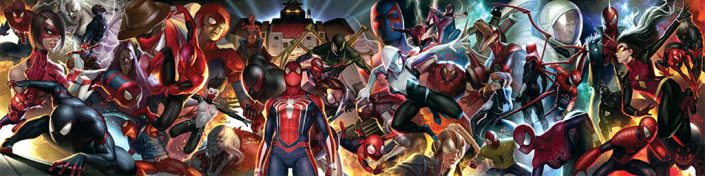
 After the Spider-Verse came Spider-Geddon. The Inheritors have escaped their radioactive prison planet and made their way to the Marvel Universe. As the villains draw first blood, a whole Spider-Army must reunite to keep them at bay! It’s more of a Miles Morales event than a Peter Parker event. As usual, check out our guide to reading the
 - Friendly Neighborhood Spider-Man Vol. 1: Secrets and Rumors
Collects Friendly Neighborhood Spider-Man (vol. 2) #1-6. Also collected in Friendly Neighborhood Spider-Man by Tom Taylor. - Amazing Spider-Man Vol. 2: Friends and Foes
Collects Amazing Spider-Man (2018) #6-10. - Amazing Spider-Man Vol. 3: Lifetime Achievement
Collects Amazing Spider-Man (2018) #11-15. - Amazing Spider-Man Vol. 4: Hunted
Collects Amazing Spider-Man (2018) #16-23, #16.HH and #18.HU-20.HU.
 War of Realms! The Dark Elf known as Malekith the Accursed has been conquering the Ten Realms one by one until there is only one left: Midgard (Earth!). Not a big event for Spider-Man, but he fought for New York, as usual. For more information, we have a
 - War of the Realms
Collects War of the Realms #1-6. - War Of The Realms: Spider-Man/Daredevil
Collects War of the Realms: Spider-Man & The League of the Realms #1-3 and material from War of the Realms: War Scrolls #1-3. - Amazing Spider-Man Vol. 5: Behind the Scenes
Collects Amazing Spider-Man (2018) #24-28. - Friendly Neighborhood Spider-Man Vol. 2: Hostile Takeovers
Collects Friendly Neighborhood Spider-Man (vol. 2) #7-14. Also collected in Friendly Neighborhood Spider-Man by Tom Taylor.
- Amazing Spider-Man By Nick Spencer Vol. 6: Absolute Carnage
Collects Amazing Spider-Man (2018) #29-31, Red Goblin: Read Death (2019) #1. - Amazing Spider-Man: Full Circle
Collects Amazing Spider-Man: Full Circle (2019) #1. An experimental tale of Spider-Man coming from eight teams of writers and artists like Gerry Duggan, Al Ewing, Chip Zdarsky, Jonathan Hickman, Jason Aaron, Nick Spencer, and Kelly Thompson. - Amazing Mary Jane: Down in Flames, Up in Smoke
Collects Amazing Mary Jane #1-5. - Amazing Spider-Man Vol. 7: 2099
Collects Amazing Spider-Man (2018) #32-36. - Amazing Spider-Man by Nick Spencer Vol. 8: Threats & Menaces
Collects Amazing Spider-Man (2018) #37-43. - Amazing Spider-Man by Nick Spencer Vol. 9: Sins Rising
Collects Amazing Spider-Man (2018) #44-47, Amazing Spider-Man: Sins Rising (2020) #1. - Amazing Spider-Man by Nick Spencer Vol. 10: Green Goblin Returns
Collects Amazing Spider-Man (2018) #48, Spider-Man: The Sins of Norman Osborn (2020) #1, Amazing Spider-Man (2018) #49, Free Comic Book Day 2020 (Spider-Man/Venom) 1 (Spider-Man story).
- Amazing Spider-Man by Nick Spencer Vol. 11: Last Remains
Collects Amazing Spider-Man (2018) #50-55. - Amazing Spider-Man: Last Remains Companion
Collects Amazing Spider-Man (2018) #50.LR-54.LR. - Amazing Spider-Man by Nick Spencer Vol. 12: Shattered Web
Collects Amazing Spider-Man (2018) #56-60.
 King in Black! The sequel to
 - King In Black
Collects King In Black (2020) #1-5. - Amazing Spider-Man By Nick Spencer Vol. 13: King’s Ransom
Collects Amazing Spider-Man (2018) #61-65, Giant-Size Amazing Spider-Man: King’s Ransom (2021) #1. - Non-Stop Spider-Man: Big Brain Play
Collects Non-Stop Spider-Man (2021) #1-5. - Savage Spider-Man (a direct sequel to Non-Stop Spider-Man)
Collects Savage Spider-Man (2022) 1-5 - Amazing Spider-Man by Nick Spencer Vol. 14: Chameleon Conspiracy
Collects Amazing Spider-Man (2018) #66-69, Giant-Size Amazing Spider-Man: Chameleon Conspiracy (2021) #1
- Sinister War
Collects Sinister War #1-4 - Amazing Spider-Man by Nick Spencer Vol. 15: What Cost Victory?
Collects Amazing Spider-Man (2018) #70-74
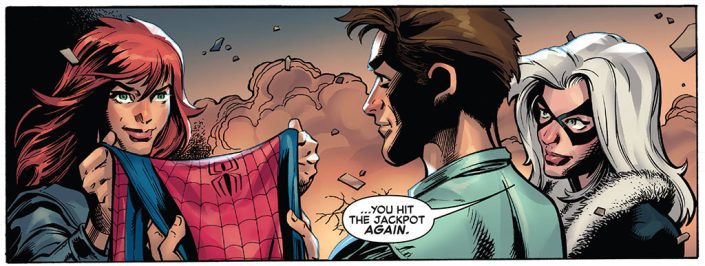
The Spider-Man: Beyond Interlude
Once Nick Spencer left the book, Marvel Comics decided to recruit multiple writers and artists—like during the Big Time period—to launch a weekly comic book subtitled “beyond.” You can learn more about it with our Amazing Spider-Man Beyond Reading Order.
- Amazing Spider-Man: Beyond Omnibus
Collects Amazing Spider-Man (2018) #75-93, 78.BEY, 80. BEY, 88. BEY, 92. BEY, 74 (Ben Reilly Story); Free Comic Book Day 2021: Spider-Man/Venom #1 (Spider-Man Story); Mary Jane & Black Cat: Beyond (2022) #1.
The Amazing Spider-Man Comics by Zeb Wells & John Romita Jr. in Order!
One of the Amazing Spider-Man: Beyond writers was destined to become the new main writer of the Amazing Spider-Man comics. The winner was Zeb Wells who teamed up with returning artist John Romita Jr. Also, it’s time to celebrate the 60th anniversary of Spider-Man’s comic book!
- Amazing Spider-Man By Wells & Romita Jr. Vol. 1: World Without Love
Collects Amazing Spider-Man (2022) #1-5. - Amazing Spider-Man by Wells & Romita Jr. Vol. 2: The New Sinister
Collects Amazing Spider-Man (2022) #6-8. - Amazing Spider-Man by Wells & Romita Jr. Vol. 3: Hobgoblin
Collects Amazing Spider-Man (2022) #9-14. - Deadly Neighborhood Spider-Man (written by Taboo)
Collects Deadly Neighborhood Spider-Man #1-5.
 The Dark Web!!! Ben Reilly and Madelyne Pryor have had enough, and they’re reigniting the Inferno! As Chasm and the Goblin Queen spin their dark web over New York City, Spider-Man and the X-Men are not ready for what’s coming! The whole event is now
 - Amazing Spider-Man by Wells & Romita Jr. Vol. 4: Dark Web
Collects Amazing Spider-Man (2022) #15-18, Dark Web #1, and Dark Web Finale #1. - Gold Goblin (written by Christopher Cantwell)
Collects Gold Goblin #1-5. Issues #2-3 are part of the Dark Web. - The Amazing Spider-Man Vol. 5: Dead Language Part 1
Collects Amazing Spider-Man (2022) #19-23. - The Amazing Spider-Man Vol. 6: Dead Language Part 2
Collects Amazing Spider-Man (2022) #24-26, annual (2023) #1, Fallen Friend #1.
🕸️Dan Slott is again writing Spider-Man stories, but not on the Amazing Spider-Man. He writes the new “Spider-Man” series, a new Superior Spider-Man series, but also spin-offs like Spider-Boy.
- Edge of Spider-Verse: Across the Multiverse
Collects Edge Of Spider-Verse (2014) #1-5, Edge Of Spider-Verse (2022) #1-5, and Edge Of Spider-Verse (2023) #1-4. The 2023 series is set after Spider-Man Vol. 1, see below. - Spider-Man Vol. 1: End of the Spider-Verse
Collects Spider-Man (2022) #1-7. - Spider-Man Vol. 2: Who Is Spider-Boy?
Collects Spider-Man (2022) #8-11. - Spine-Tingling Spider-Man by Saladin Ahmed
Collects Spine-Tingling Spider-Man #0-4. - The Amazing Spider-Man Vol. 7: Armed and Dangerous
Collects Amazing Spider-Man (2022) #27-31 and material from FCBD 2023: Spider-Man/Venom. - Superior Spider-Man Vol. 1: Supernova
Collects Superior Spider-Man Returns #1, Superior Spider-Man (2023) #1-4, and material from Amazing Spider-Man (2022) #31. - Superior Spider-Man Vol. 2: Superior Spider-Island
Collects Superior Spider-Man (2023) #5-8. - Spider-Boy Vol. 1: The Web-Less Wonder
Collects Spider-Boy (2023) #1-4 and material from Amazing Spider-Man (2022) #31.
 Spider-Boy is its own thing (Dan Slott’s thing). Peter Parker appears in the series, but the Spider-Boy comics are not connected to the Amazing Spider-Man comics series. The next books will not be added to this reading order unless the Little Spider hero joins the big one for a crossover.
- The Amazing Spider-Man Vol. 8: Spider-Man’s First Hunt
Collects Amazing Spider-Man (2022) #32-38.
 Gang War!!! New York City’s super-crime landscape has been a ticking time bomb, and now it has finally exploded! As NYC becomes an open battlefield for a ruthless supervillain conflict, the wall-crawler will need an amazing team. The whole event is now
 - Amazing Spider-Man by Zeb Wells Vol. 9: Gang War
Collects Amazing Spider-Man: Gang War Prelude (2023) #1, Amazing Spider-Man (2022) #39-44. - Amazing Spider-Man by Zeb Wells Vol. 10: Breathe
Collects Amazing Spider-Man (2022) #45-49, and material from FCBD 2024: Spider-Man/Ultimate Universe and Web of Spider-Man (2024) #1. - Jackpot and Black Cat
Collects Jackpot & Black Cat (2024) #1-4, Jackpot (2024) #1. A Black Cat/MJ team-up book.
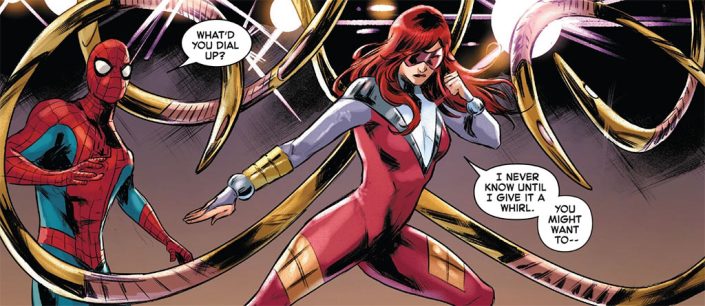
 With issue #49 of Amazing Spider-Man, Peter Parker joined Marvel’s Blood Hunt as one of the heroes trying to stop the vampire invasion in New York. He teams up with Misty Knight and The Lizard to track down Morbius, the Living Vampire! You can stick with the next paperback, but if you want to read the event, I invite you to check out our
 - Amazing Spider-Man: Blood Hunt
Collects Amazing Spider-Man: Blood Hunt (2024) #1-3, Amazing Spider-Man (2022) #49, Miles Morales Spider-Man (2023) #21-22. - The Spectacular Spider-Men Vol. 1: Arachnobatics
Collects Spectacular Spider-Men (2024) #1-5 and material from Web of Spider-Man (2024) #1. A Peter Parker and Miles Morales team-up book by Greg Weisman and Humberto Ramos. - The Spectacular Spider-Men Vol. 2: Elementary
Collects Spectacular Spider-Men (2024) #6-10. - The Spectacular Spider-Men Vol. 3: Strange Love
Collects Spectacular Spider-Men (2024) #11-15. - Amazing Spider-Man by Zeb Wells Vol. 11: Going Green
Collects Amazing Spider-Man (2022) #50-54.
- Venom War
Collects Venom War (2024) #1-5. - Venom War: Spider-Man/Lethal Protectors
Collects Venom War: Spider-Man (2024) #1-4, Venom War: Lethal Protectors (2024) #1-3, Venom War: Fantastic Four (2024) #1, Venom War: It’s Jeff (2024) #1. - Amazing Spider-Man by Zeb Wells Vol. 12: Dead Wrong
Collects Amazing Spider-Man (2022) #55-60.
The Amazing Spider-Man Comics by Joe Kelly in Order!
Writer Joe Kelly and artist Ed McGuinness took over the series for a story arc titled “The 8 Deaths of Spider-Man,” in which Doctor Doom, now the Sorcerer Supreme (read Blood Hunt to know about that), gives Spider-Man a magic-powered suit and eight extra lives to help him save the world. This led to the One World Under Doom event, but that event barely concerned Spidey at all.
- Amazing Spider-Man: 8 Deaths of Spider-Man
Collects Amazing Spider-Man (2022) #61-70. - Spider-Man & Wolverine Vol. 1: The Janus Directory [2026]
Collects Spider-Man & Wolverine (2025) #1-5. - Spider-Man & Wolverine Vol. 2: Life & Death Choices [2026]
Collects Spider-Man & Wolverine (2025) #6-10. - Spider-Verse vs. Venomverse [2026]
Collects Spider-Man & Wolverine (2025) #6-10.
- The Amazing Spider-Man Vol. 1: Get Back Up
Collects Amazing Spider-Man (2025) #1-5, Amazing Spider-Man (2022) #70 (B story), Free Comic Book Day 2025: Amazing Spider-Man/Ultimate Universe #1 (Amazing Spider-Man story). - The Amazing Spider-Man Vol. 2: Through the Gates of Hell [2026]
Collects Amazing Spider-Man (2025) #6-10. - The Amazing Spider-Man Vol. 3: Resolute [2026]
Collects Amazing Spider-Man (2025) #11-16. - The Amazing Spider-Man Vol. 4: Broken [2026]
Collects Amazing Spider-Man (2025) #11 (B-E stories), #13, #15, #17, #19, #22 - Amazing Spider-Man/Venom: Death Spiral [2026]
Collects Amazing Spider-Man/Venom: Death Spiral (2026) #1, Amazing Spider-Man (2025) #23-27, Venom (2025) #255-257, Amazing Spider-Man/Venom: Death Spiral – Body Count (2026) #1, Free Comic Book Day 2025: Amazing Spider-Man/Ultimate Universe #1 (C Story)
Did we forget an important issue? Did we make a mistake? Let us know in the comments!
Enorme Travail. Merci Beaucoup!
you are forgetting Spider-Man (2023) by Dan Slott, the End of the Spider-verse and the introduction of Spider-boy
As you may have noticed, we are not building our Reading Orders on single issues, but on collected editions. We usually update those guides a few times a year to add the most recent collections published. If one of the last books is not yet present in the guide, it’s because it’s not available for now or we haven’t had the time to update. But as it is the last one, all you have to do is read it last. If you’re into spider-boy, his first appearance will be available in TPB mid-November.
Missing: Peter Parker Spider-Man Vol. 1: A Day in the Life which collects Peter Parker: Spider-Man #’s 20-22, 26 and Webspinners #10-12. These stories happen right after Spider-Man: The Next Chapter Vol. 3
Yes, indeed! I totally skipped that book for some reason. But it is in the list now. Thanks for your help James!
Is the omnibus the shortcut to every spider comic you state, or is it just the shortcut to a specific comic?
It’s Civil War missing?
Yes, what a strange occurence. It used to be there, but I probably deleted it by accident when I did an update. Anyhow, I put the Civir war section back in! Have a good read!
I can’t seem to place where Infinity Abyss fits so that I can place The Evil That Men Do in a near proper place. I know I’ve seen it elsewhere but neither the Avengers, X-Men, Cosmic, Inhumans, and Thanos give a clear indication of where it might fit best among the major events. Please help?
I don’t think you’ll find someone who’d call Infinity Abyss a Major Events. Personally, I didn’t even remember it existed until I read your comments, so I will not be able to help you here. It’s a Thanos series by Jim Starlin, not sure it had any impact on the other characters. Back in 2002, there were a lot less events and other crossovers and attention on immediate continuity–not that they do a good job with that now. Good luck to you.
Ngl stuff after gang war has been boring asf fr like all we’re getting is some “EAsY BEinG GREen” arc shit which only two issues in to the arc is already boring norman ISINT even the green goblin in it
Hey Fabien
Is Amazing Spider-man Vol.1: The Goblin Lives Collection (#53-67) important to the overall Spider-Man story?
Like a lot of stories from that time, some are just comebacks of regular foes but with a new energy (Romita did things diffrently from Ditko), but this volume adds to the relationship between Doc Ock and Aunt May (the first 4-issues are Spidey vs Doc Ock, classic stuff), and there’s the introduction of Captain Stacy, and a bit of notable developments in the Goblin/Norman Osborn saga. Overall, it was Stan Lee and John Romita Sr doing pretty good things. I think it’s not one to skip.
want to acquire comics for a five year old boy.
Hi there! Are ASM issues 282-288 collected anywhere? It seems to jump straight from vs. Silver Sable to #289, so it’s a little confusing to follow.
ASM #282 is collected in X-Factor Epic Collection: Genesis & Apocalypse, but the ASM #283 to #288 (aka the original Gang War storyline) have not been collected for now. This will change soon I guess. We should find them in the next volume of the Marvel Masterworks and in volume 16 of the Epic Collection, but not date has been announced for either of those books.
Would the Zdarsky Spectacular run be structured differently? Issues 297-307 are one continuous narrative, with no real time for breaks. The trades collected that arc poorly. They even put the annual in the wrong volume (before that arc ended).
Hey Dylan,
Thanks for your comment! I take a look at the run (it’s been a long time since I read it). So I opted to move Spectacular Volume 4 with the two previous volumes, but put a note to tell reading the last issues later. I placed them (with the annual) after the end of Dan Slott’s run. I know it was published at the start of Fresh Start, but I’m pretty sure it can be read here (if not, tell me!).
I don’t like it when we have to put a trade on hold, but interrupting a story arc is no better, so hopefully this is better!
I think that works well! As long as the Jonah interview happens before the end of Slott’s run, I think that new order works! I know Slott referenced that too.
I don’t see the ultimate spiderman series?
You’ll find everything about the Ultimate Spider-Man here.